
Five modes, zero explanation
Once you’ve got Shogi Wars switched into English, you hit the next wall almost immediately: the mode selection screen. Five options, no context, and an app that assumes you already know what any of them are for. It doesn’t tell you which one teaches you anything, which one is a trap for a beginner, or which order to work through them in. It just hands you a menu and gets out of the way.
I’ve played all five modes for long enough to have opinions about them, some of them fairly strong. This is the traffic-cop version of that experience: what each mode actually is, what it’s good for, and — the part the app will never tell you — the order I’d play them in if I were starting over.
The mode selection screen, decoded
Tap GAME START on the home screen and you land on Rank Match, where three tabs sit across the top: Normal, Sprint, and Mate Battle. Normal isn’t one mode, it’s three time controls stacked under a single tab — 10 minutes, 3 minutes, and 10 seconds per move. Add Sprint and Mate Battle and you’ve got five distinct ways to play, each running its own separate rank.
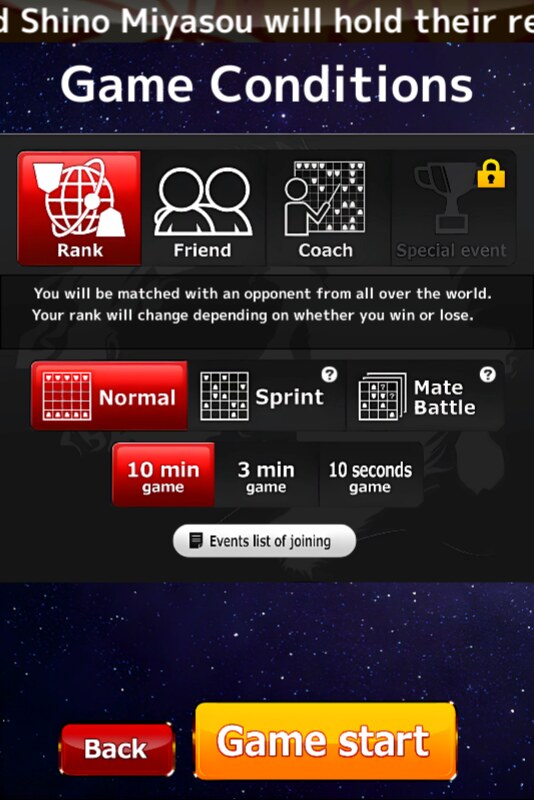
That last point matters more than it looks: the app tracks a separate rank for each mode, visible on your My Page, and according to the in-app dan certification page, you can apply for an official JSA rank certificate using whichever mode you’ve climbed highest in. Grinding 10-second games to a high rank counts just as much toward that certificate as grinding 10-minute games. Keep that in your back pocket; it comes up again below.
The five modes
10-minute games
Each side gets 10 minutes total, sudden death. Run out and you lose on the spot — the app’s own description is blunt about it: “You lose as soon as you overrun the allotted time. There is no extension of time.” No byoyomi, no increment, no grace period.
Who it’s for: anyone who actually wants to think during a shogi game. Ten minutes a side is short by classical standards but it’s the only format on this app where you have real room to sit and calculate.
The catch: ten minutes evaporates faster than it sounds like it should, especially once a position gets complicated. My advice — don’t burn your clock in the opening. The opening moves are the ones you’re most likely to know from memory or from a quick glance at a joseki chart; save the thinking time for the middlegame branch points, where the games are actually decided.
3-minute games
Same sudden-death structure, compressed to 3 minutes a side. The official description is identical in spirit: “You lose as soon as you overrun the allotted time. There is no extension of time.” You just have a third of the clock to do it in.
Who it’s for: players who already have a working sense of the position and want to test it at speed. It’s also, I’ll admit, one of the more habit-forming things in this hobby — there’s a particular itch to “just one more 3-minute game” that I have not fully solved in several years of playing.
The catch: at this speed, the clock is a weapon, not just a constraint. If you’re ahead, the correct move is often the one that simplifies the position rather than the technically best move, because a simpler position is faster to play and harder to blunder in under time pressure. Winning on the clock is a slightly undignified way to win a shogi game. It still counts.
10-second games
One move, ten seconds, no exceptions. The app states it as plainly as the others: “You have 10 seconds per move.” Ten seconds isn’t a soft target here, it’s the whole game.
Who it’s for: players who already have some pattern recognition built up and want to fire it off on a hair trigger. This is not a mode for building understanding; it’s a mode for testing whether understanding you already have has become automatic.
The catch: protect your rhythm. The moment you try to calculate something you can’t finish in ten seconds, you’ve usually already lost the thread of the position and made it worse than if you’d just played the first reasonable move you saw. Overcomplicating a 10-second game is a way of strangling yourself with your own cleverness.
Sprint
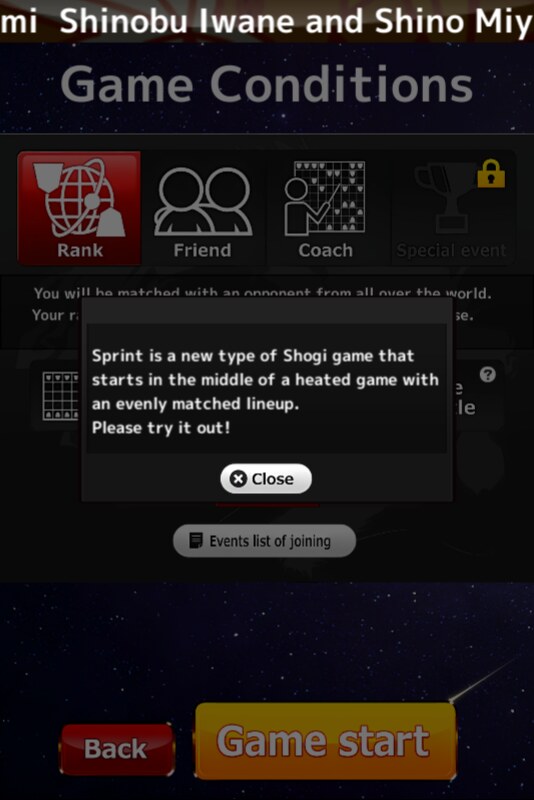
Sprint arrived in February 2025. Instead of starting from move one, an AI called Kishin pulls you directly into an evenly matched middlegame or endgame position lifted from a real Shogi Wars game — 140,000 positions in the pool at launch — and you play it out with a 3-minute sudden-death clock. The app’s own framing: “Sprint is a new type of Shogi game that starts in the middle of a heated game with an evenly matched lineup.” No opening theory required, because there’s no opening.
Who it’s for: anyone whose opening is fine but who freezes the moment the position gets messy in the middlegame — which, statistically, is most people who’ve only played 10-minute games so far.
The catch: because you’re dropped into a position mid-thought, don’t move on reflex. Give yourself a genuine ten seconds just to look at the whole board — king safety, material, which side has the initiative — before you touch a piece. Sprint punishes players who start calculating a line before they’ve actually assessed the position they’re in.
One practical note: the app matches your first few Sprint games against your existing Normal rank, so there’s no cold start where you’re thrown against players wildly out of your league.
Mate Battle (詰めバト)
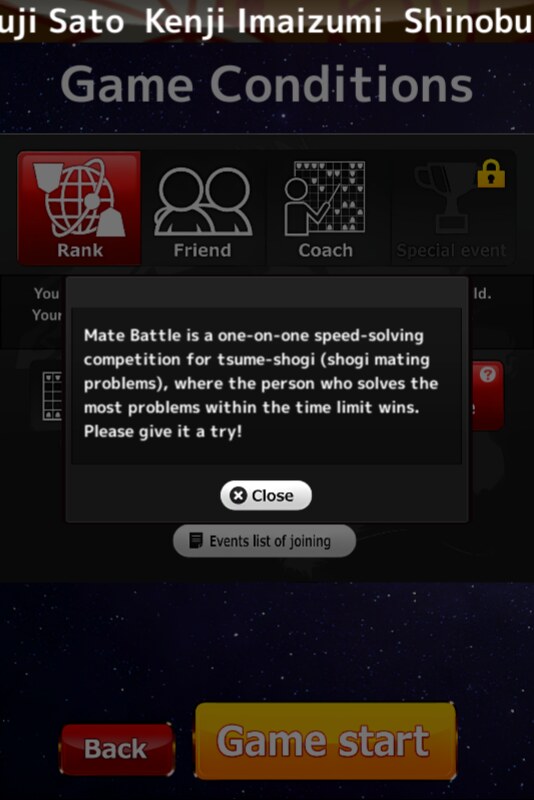
The newest mode, added in June 2026. Mate Battle is a head-to-head speed-solving race: you and your opponent work through ten tsume-shogi problems, pulled from real game positions, with three minutes on the clock. Whoever solves more wins; a tie goes to whoever finished first. The app describes it simply: “Mate Battle is a one-on-one speed-solving competition for tsume-shogi (shogi mating problems), where the person who solves the most problems within the time limit wins.”
Who it’s for: honestly, everyone, but especially total beginners. This is the one mode where you don’t need opening knowledge, middlegame judgment, or endgame technique — you need to know how the pieces move and nothing else.
The catch: read the mate all the way to the end before you play your first move. Speed-solving rewards commitment, not exploration, and a false start costs you seconds you don’t get back across ten problems.
The order I’d actually practice these in
Here’s the part the app will never tell you, so I’ll say it plainly: Mate Battle first, then 10-minute games with Sprint alongside them, and 3-minute or 10-second games last. Not roughly in that order — in that order. I’d defend this to anyone who’s played the app as long as I have.
The reasoning comes from one fact about shogi that’s easy to lose sight of when you’re staring at a mode menu: the entire game exists to produce a checkmate. Every opening system, every piece formation, every tempo you spend is in service of eventually delivering mate or avoiding one. So learn the game backward, starting from the part it’s actually about.
Start with Mate Battle. You need nothing but the rules of how pieces move to play it, which means it’s the one mode with zero prerequisite knowledge. More importantly, it’s the fastest way to build a library of mating patterns in your head — the specific shapes that lead to checkmate — and those patterns are the single most transferable skill in the whole game. They show up in every other mode you’ll play. And because each set is capped at three minutes, a bad round costs you almost nothing. Our beginner’s guide to tsume shogi is worth reading alongside this if the mating patterns themselves feel unfamiliar.
Move to 10-minute games as your main event, with Sprint in support. Ten minutes is the only format where you have room to actually think, which makes it the format where you experience a full game — opening, middlegame, endgame — the way it’s meant to unfold. It’s your primary training ground, and pairing it with opening fundamentals for beginners will keep you from bleeding time in the first fifteen moves. Sprint earns its place right alongside it, not after it, because it isolates the exact skill that 10-minute games expose as weakest in most beginners: knowing what to do once the opening book runs out. Sprint skips straight to that problem and lets you repeat it at high density.
Save 3-minute and 10-second games for last. Speed formats don’t teach you new judgment, they just pull the judgment you already have out of you faster. Play them before you have real patterns built up and you’re not training speed, you’re training sloppiness — and sloppy habits formed under time pressure are stubborn to unlearn later. Earn the speed by having something worth speeding up first.
And once the mating patterns from all that Mate Battle start following you around — showing up on the ceiling when you’re trying to sleep — that’s usually the point where people want to set up positions on a real board and push actual pieces around. Our shogi set buying guide covers what’s worth getting for a first board without overspending.
FAQ
What are the Shogi Wars modes? Five total: three Normal time controls — 10 minutes, 3 minutes, and 10 seconds per move, all sudden death — plus Sprint and Mate Battle. Each mode tracks its own separate rank.
What is Sprint mode in Shogi Wars? Added in February 2025, Sprint drops you into an evenly matched middlegame or endgame position pulled from a real Shogi Wars game, then you play it out with a 3-minute sudden-death clock. There’s no opening phase.
What is Mate Battle in Shogi Wars? Added in June 2026, Mate Battle is a one-on-one speed-solving race against another player: ten tsume-shogi problems pulled from real games, three minutes on the clock, and whoever solves the most wins.
Which Shogi Wars mode should a beginner start with? Mate Battle first, since it needs no opening or middlegame knowledge and builds mating pattern recognition fast. Then make 10-minute games your main mode with Sprint as a supplement, and leave 3-minute and 10-second games until you’ve got real patterns to speed up.
Do Shogi Wars modes share a rank? No. The app tracks a separate rank for each of the five modes, viewable on your My Page, and according to the in-app dan certification page you can apply for an official JSA rank certificate using your highest rank from any of them.