In riichi mahjong you cannot win on shape alone. You can draw a perfect hand of four sets and a pair, tiles all in order, and still be unable to declare a win, because the rules ask one more thing of you: at least one yaku.
A yaku is a named scoring pattern. Riichi is a yaku. All Simples is a yaku. A triplet of dragons is a yaku. Your hand needs to contain at least one of them, and each yaku is worth a number of han (doubles) that feeds into the final score. No yaku, no win, no matter how complete the tiles look. This is the single rule that trips up almost every beginner arriving from Mahjong Soul, where the win button simply refuses to light up and nothing on screen explains why. If you are still learning the flow of a hand, start with the beginner’s guide to riichi mahjong and come back here to look things up.
This page is that lookup. Every scoring pattern you are likely to meet, grouped by value, in tables you can scan or search. Bookmark it, then use it the way I do: not to memorize, but to check.
One thing that is not a yaku: dora
Before the tables, clear up the most common scoring confusion in the game. Dora are not yaku. They are bonus tiles that add han to a hand that already has a yaku, and they cannot get you a win by themselves. A hand made entirely of dora with no actual yaku is not a legal win.
Dora come in three forms:
| Type | Romaji | When it counts |
|---|---|---|
| Regular dora | dora | A flipped indicator tile in the dead wall marks the dora; every copy in your hand is worth 1 han. |
| Ura dora | ura dora | A second, hidden indicator, revealed only if you won with a declared riichi. Called hands never get ura dora. |
| Red fives | aka dora | Special red 5 tiles worth 1 han just by being held. An optional rule, on by default in most online clients. |
Dora inflate scores dramatically, which is why a plain riichi can suddenly pay big. But the han they add sit on top of a yaku; they never replace one. Keep that distinction and half the “why didn’t this win?” moments disappear.
How to read these tables
A few conventions run through everything below.
- Closed / Open columns give the han value with a concealed hand versus a hand that has claimed a tile (pon, chii, or an open kan). A dash (—) in the Open column means the yaku disappears if you open your hand; it is closed-only.
- Kuisagari (食い下がり) is the term for a yaku that survives being opened but drops one han. You will see it as, say, 2 closed and 1 open. Where both columns match, opening costs you nothing.
- Notation in the worked examples uses number + suit (
pcircles,sbamboo,mcharacters) and letters for honors:E S W Nfor the East/South/West/North winds andWh G Rfor the White, Green, and Red dragons. So234pis 2-3-4 of circles andRRRis three Red dragons. - Total count. Rulesets tally the yaku differently, mostly over how they count the value-tile yaku and a few rare shapes, so you will see totals quoted anywhere from the mid-twenties to forty-plus. The patterns themselves, below, are stable across standard rules; the headcount is just bookkeeping.
1 han yaku
The bread and butter. Most of your wins will be built from these, often stacked two or three deep.
| Yaku | Romaji | Kanji | Closed | Open | What it is |
|---|---|---|---|---|---|
| Ready hand | riichi | 立直 | 1 | — | Declared when your closed hand is one tile from complete; costs a 1,000-point bet. |
| Self-draw | menzen tsumo | 門前清自摸和 | 1 | — | Winning on your own drawn tile with a fully closed hand. |
| One-shot | ippatsu | 一発 | 1 | — | Winning within one go-around after declaring riichi, before your next discard. |
| Under the sea | haitei raoyue | 海底撈月 | 1 | 1 | Winning on the very last drawable tile of the wall. |
| Under the river | houtei raoyui | 河底撈魚 | 1 | 1 | Winning on the very last discard of the hand. |
| After a kan | rinshan kaihou | 嶺上開花 | 1 | 1 | Winning on the replacement tile drawn after declaring a kan. |
| Robbing a kan | chankan | 搶槓 | 1 | 1 | Winning on a tile an opponent adds to an existing pon to form a kan. |
| No-points hand | pinfu | 平和 | 1 | — | All runs, a valueless pair, and a two-sided final wait. The “no extra fu” hand. |
| Pure double sequence | iipeikou | 一盃口 | 1 | — | Two identical runs, same suit and same numbers. |
| All simples | tanyao | 断么九 | 1 | 1 | No terminals (1s and 9s) and no honor tiles; every tile is a 2 through 8. |
| Value tiles | yakuhai | 役牌 | 1 | 1 | A triplet of dragons, your seat wind, or the round wind. One han per such triplet. |
A word on the last two, since they do the heavy lifting. Yakuhai stacks: a hand with a Red dragon triplet and a triplet of the round wind is 2 han, one for each. It also does not care whether you open your hand, which makes it the most reliable path to a fast, legal, called-hand win. All simples is the other workhorse; some older or in-person rulesets require it to be closed (a rule called kuitan nashi), but under the default online rules an open all-simples hand scores its 1 han fine.
2 han yaku
Bigger shapes, and the first place kuisagari appears.
| Yaku | Romaji | Kanji | Closed | Open | What it is |
|---|---|---|---|---|---|
| Seven pairs | chiitoitsu | 七対子 | 2 | — | Seven distinct pairs instead of the usual four-sets-and-a-pair shape. Closed only. |
| All triplets | toitoi | 対々和 | 2 | 2 | Four triplets (or kans) and a pair; no runs at all. |
| Three concealed triplets | sanankou | 三暗刻 | 2 | 2 | Three triplets formed without claiming a tile for them. |
| Three-color triplets | sanshoku doukou | 三色同刻 | 2 | 2 | The same numbered triplet in all three suits, e.g. 5-5-5 of each. |
| Three kans | sankantsu | 三槓子 | 2 | 2 | Three quads (kans) in one hand. |
| Three-color straight | sanshoku doujun | 三色同順 | 2 | 1 | The same run in all three suits, e.g. 3-4-5 of each. Kuisagari. |
| Pure straight | ittsuu | 一気通貫 | 2 | 1 | The 1-2-3, 4-5-6, and 7-8-9 runs in a single suit. Kuisagari. |
| Terminal/honor in each set | chanta | 混全帯么九 | 2 | 1 | Every set and the pair contains a terminal or an honor tile. Kuisagari. |
| All terminals and honors | honroutou | 混老頭 | 2 | 2 | Only 1s, 9s, and honor tiles; always combines with all triplets or seven pairs. |
| Little three dragons | shousangen | 小三元 | 2 | 2 | Two dragon triplets plus a pair of the third dragon. |
Seven pairs is the odd one out structurally, and worth a mental note: it is fixed at 25 fu and, being closed-only, pairs naturally with riichi. Little three dragons looks like only 2 han on paper, but it always drags two yakuhai dragon triplets along with it, so the real hand is usually 4 han or more before dora.
3 han and 6 han yaku
The high end of the han ladder, before you reach yakuman territory. Two of these are the “flush” hands that decide a lot of big pots.
| Yaku | Romaji | Kanji | Closed | Open | What it is |
|---|---|---|---|---|---|
| Half flush | honitsu | 混一色 | 3 | 2 | One suit plus honor tiles, nothing from the other two suits. Kuisagari. |
| Twice pure double sequence | ryanpeikou | 二盃口 | 3 | — | Two separate pairs of identical runs. Closed only. |
| Fully outside hand | junchan | 純全帯么九 | 3 | 2 | Like chanta, but every set and the pair contains a terminal (no honors). Kuisagari. |
| Full flush | chinitsu | 清一色 | 6 | 5 | A single suit and nothing else: no honors, no other suits. Kuisagari. |
Full flush is the big one here. At 6 han closed it is already worth a haneman-level payout before any dora, and a closed chinitsu that also rides a riichi and a couple of ura dora is where casual games turn into blowouts.
Yakuman: the limit hands
Yakuman sit outside the han ladder entirely. Instead of adding doubles, each one pays a fixed limit score (in standard scoring, 32,000 for a non-dealer win, 48,000 for the dealer). Some are closed-only, some can be made with called tiles; the table notes which.
| Yakuman | Romaji | Kanji | Closed only? | What it is |
|---|---|---|---|---|
| Thirteen orphans | kokushi musou | 国士無双 | Yes | One of every terminal and honor tile, plus a second copy of any one of them. |
| Four concealed triplets | suuankou | 四暗刻 | Yes | Four triplets, none of them claimed from a discard. |
| Big three dragons | daisangen | 大三元 | No | Triplets of all three dragons. |
| Little four winds | shousuushii | 小四喜 | No | Triplets of three winds plus a pair of the fourth. |
| Big four winds | daisuushii | 大四喜 | No | Triplets of all four winds. Often scored as a double yakuman. |
| All honors | tsuuiisou | 字一色 | No | A hand made entirely of honor tiles. |
| All terminals | chinroutou | 清老頭 | No | A hand of nothing but 1s and 9s. |
| All green | ryuuiisou | 緑一色 | No | Only the “green” tiles: 2, 3, 4, 6, 8 of bamboo and the Green dragon. |
| Nine gates | chuuren poutou | 九蓮宝燈 | Yes | A specific full-flush shape (1112345678999 + one extra) in one suit. |
| Four kans | suukantsu | 四槓子 | No | Four quads declared in one hand. |
| Blessing of heaven | tenhou | 天和 | Yes | The dealer completing a winning hand on the opening draw. |
| Blessing of earth | chiihou | 地和 | Yes | A non-dealer winning on their first draw, before any call interrupts. |
Two honest caveats here, because rulesets genuinely disagree.
Double yakuman. Several hands are commonly upgraded to double value in their most extreme form: thirteen orphans on a thirteen-tile wait, four concealed triplets completed on a single (pair) wait, nine gates on the pure nine-sided wait, and big four winds. Whether any given table honors those doublings depends on the ruleset; some clients pay them, some flatten everything to a single yakuman. Check the rules of the platform you are on rather than assuming.
Blessing of man (renhou, 人和), a non-dealer winning on the first go-around off a discard, is a local yaku whose value swings from a full yakuman down to a mere mangan depending on where you play, and plenty of standard rulesets omit it entirely. There is also nagashi mangan, an oddity where a player whose every discard is a terminal or honor and untouched by any call scores a mangan at the exhaustive draw. Both are edge cases; treat their presence and value as table-dependent.
Worked examples
Tables tell you the rule; a picture tells you what it looks like at the table. Here are the ones worth seeing.
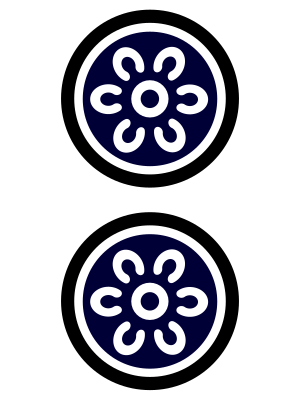
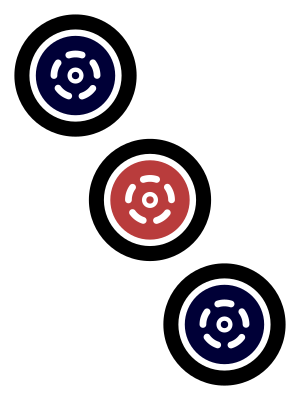
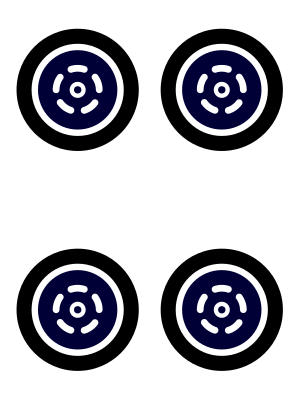
Riichi is not a shape you build so much as a declaration you make. Any closed hand that reaches tenpai (one tile from a win) can declare it:
All simples (tanyao) is the pattern you will complete most often. Nothing but 2s through 8s, no terminal or honor tile anywhere:
No-points hand (pinfu) is all four groups as runs, a valueless pair, and a two-sided wait, the “no extra fu” hand:
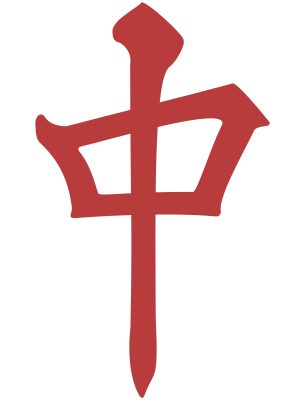
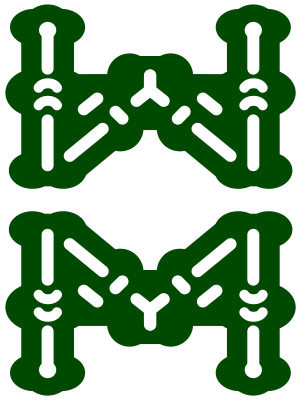
Value tiles (yakuhai) needs just one triplet of a dragon, your seat wind, or the round wind. Here, a triplet of Red dragons carries the whole hand:
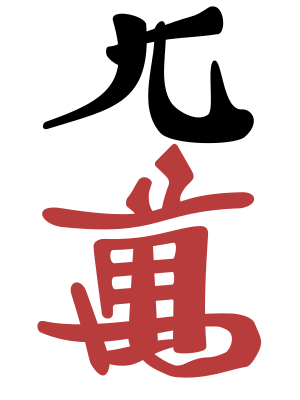
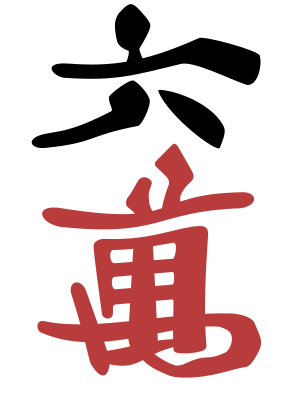
Three-color straight (sanshoku) runs the same sequence through all three suits, an easy pattern to spot once you look for it:
The cheat sheet
If you take one screenshot from this page, take this. The yaku you will actually see, sorted by how often they turn up:
- You will lean on constantly: riichi (1), tanyao (1), yakuhai (1 each), pinfu (1), menzen tsumo (1). Most closed wins are some combination of these plus dora.
- Worth reaching for: sanshoku (2/1), ittsuu (2/1), iipeikou (1), chiitoitsu (2), toitoi (2). Shape goals that add real value without twisting your hand into knots.
- Big-pot territory: honitsu (3/2), chinitsu (6/5), shousangen (2, but drags dragon triplets), junchan (3/2).
- Once in a blue moon: the yakuman table above. Learn to recognize them so you know when to chase.
And the two rules underneath all of it: every win needs at least one yaku, and dora are never that yaku, only a bonus on top.
For the flip side of the scoring picture, how a win is actually paid for and by whom, read tsumo vs ron. And if you are still assembling the basics, the beginner’s guide to riichi mahjong walks through a full hand from the first draw. These patterns stick a lot faster with actual tiles in your hand than they do on a screen, and our roundup of the best riichi mahjong sets covers which ones are worth buying for it.