Seen riichi mahjong in an anime and thought “I want to play that”? You’re in the right place. And no, it’s not American mahjong — this is the Japanese game from the anime, and it plays by very different rules.
Here’s the problem you’ve probably already run into. You search “mahjong rules” and get three different games blended into one article. You open a rules wiki and drown in romanized terms nobody defines. You install Mahjong Soul, finish a hand, and the win button simply isn’t there — and nothing you’ve read explains why.
This guide fixes that. It teaches riichi mahjong in the order that actually works: first the minimum you need to play one game tonight, then the concepts that make you competent, and, just as important, an explicit list of things you’re allowed to ignore for now. I live in Japan, where this game is part of everyday life; I play online, own a physical set, and have played in Japanese mahjong parlors. My job here is to translate a game that’s everywhere in Japan into plain English, one step at a time.
The Five Things You Need to Play Tonight
Here is the whole game up front; the rest of this article unpacks each point:
- The goal. Build four sets of three tiles (runs or triplets) plus one pair, a 14-tile winning shape.
- The turn. Draw one tile, discard one tile, repeat; play continues until someone wins or the tiles run out.
- Don’t call. Skip the options to claim other players’ discards (chii/pon/kan) and keep your hand closed.
- Riichi. When your closed hand is one tile from complete, declare riichi: bet 1,000 points and lock your hand in.
- The catch. A winning hand also needs at least one yaku (scoring pattern), and riichi is itself a yaku, so rule 4 keeps every win legal.
Install a free client, follow those five, and you can finish a real game tonight. Everything below explains why they work.
One thing to settle before the details: make sure you’re learning the right game. Riichi (Japanese) mahjong is the four-player game from anime like Akagi and Saki, played on Mahjong Soul, Tenhou, and Riichi City with 136 tiles and no jokers; it’s the version this entire guide, and this entire site, covers. American mahjong — the National Mah Jongg League game with jokers, a Charleston passing phase, and a card of valid hands reissued every year — is a different game, and nothing in this guide applies to it. Other regional variants like Hong Kong mahjong exist too, but you don’t need them today. The variant differences matter most when buying physical tiles, and our riichi set buying guide sorts that out. From here on, “mahjong” means riichi.
The Goal: Build Four Sets and a Pair
Every hand of riichi mahjong is a race toward one shape:
Four groups of three tiles + one pair = 14 tiles.
That’s a winning hand. (There are two rare exceptions, a hand of seven pairs and one exotic hand called thirteen orphans, but forget them for now.)
A “group of three” (the Japanese term is mentsu, usually translated as a set or meld) comes in two everyday forms:
- A run (shuntsu): three consecutive numbers in the same suit, like 4-5-6 of circles.
- A triplet (koutsu): three identical tiles, like three Red Dragons.
There’s also the quad (kan), four identical tiles, which counts as one set with special handling you can safely ignore for your first games.
Here’s what a complete winning hand looks like:


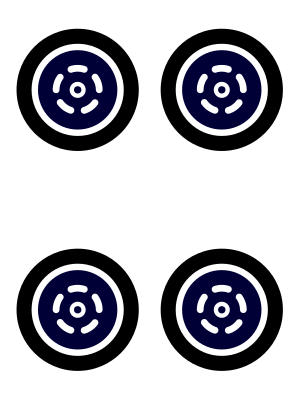


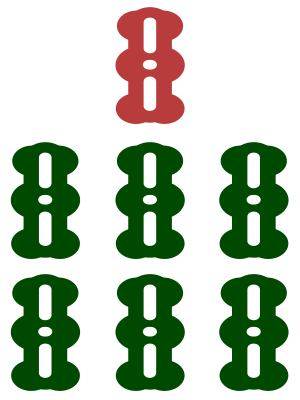
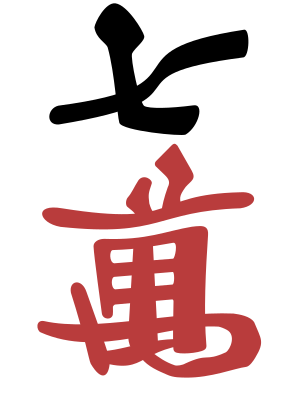

If you’ve ever played rummy or gin rummy, this should feel familiar: you’re drawing and discarding to assemble sets, one tile at a time. That instinct carries over almost perfectly. Mahjong just plays it with tiles, four players, and, as we’ll see, one extra rule about which winning hands actually count.
Notice what we’re not talking about yet: points, special hand names, defensive play. The single biggest mistake beginners make is trying to learn scoring before they can complete a hand, so get comfortable building this shape before you spend a minute on anything else.
Meet the Tiles (in Plain English)
A riichi set has 136 tiles: 34 different kinds, four copies of each. The 34 kinds break down into two families.
Number tiles (three suits, 1–9 each)
- Circles (pinzu): tiles showing 1–9 circles. The easiest suit to read: just count the dots.
- Bamboo (souzu): tiles showing 1–9 bamboo sticks. Warning: the 1 of bamboo is drawn as a bird, not a stick. Every beginner gets tricked by this at least once; the sparrow-looking tile is a “1.”
- Characters (manzu): numbers written as Japanese/Chinese numerals (一, 二, 三…) with 萬 underneath. This is the suit that intimidates Western beginners, but you don’t need to read Japanese; you just need to recognize nine symbols, and after a few games you will. Online clients usually offer an option to print small Arabic numerals on the tiles, so this problem mostly solves itself.
You’ll see the Japanese suit names pin, sou, and man everywhere in the community (e.g., “3p” = 3 of circles, “7s” = 7 of bamboo, “2m” = 2 of characters). I’ll use the English names in this article, but learn the shorthand; every strategy resource uses it.
Honor tiles (no numbers)
- Winds: East, South, West, North. Four of each.
- Dragons: White (often a blank tile or a simple frame), Green (発), and Red (中). Four of each.
Honors can only form triplets or pairs; there’s no such thing as a “run” of East-South-West.
That’s the whole inventory: 9 + 9 + 9 numbers plus 7 honors = 34 kinds. Modern Japanese sets also include red fives: one red-tinted 5 in each suit that replaces a normal 5 and gives bonus value. They’re standard in most online play; we’ll touch on them in the scoring section.
One thing a screen quietly does for you: it sorts your hand and labels everything. I’ve played plenty of real-table mahjong in Japan, including parlor sessions that ran until dawn, and reading the suits at a glance on physical tiles takes noticeably more repetition than an app ever asks of you.
How a Turn Works: Draw, Discard, Repeat
The mechanics of a turn are almost embarrassingly simple.
- Draw one tile from the wall (the shuffled supply of face-down tiles). You now have 14 tiles.
- Check: does this tile complete your hand? (If yes, and one more condition we’ll get to, you win.)
- Discard one tile face-up in front of you. You’re back to 13 tiles.
Play passes counterclockwise, and everyone repeats draw-discard until someone wins or the wall runs out (an “exhaustive draw,” roughly a pushed round, with a small settlement we’ll skip).
Your discards go in neat rows of six in front of you, in order. This isn’t just tidiness: your discard row is public information that other players read, and one rule later in this guide depends on it. Online clients arrange discards automatically, so you get this for free.
The frame around the turns
A quick sketch of the bigger structure, kept to the minimum you need:
- Each player starts with 13 tiles and a stack of points (commonly 25,000).
- One player is the dealer (oya, the East player). The dealer rotates after most hands; if the dealer wins, they stay dealer for another hand.
- A full game is a sequence of hands. An East-round game (tonpuusen) goes around the table once; a half game (hanchan, East + South rounds) goes around twice and is the standard competitive length. Highest score when the rounds run out wins.
Calls: the thing you should ignore tonight
You’ll quickly notice you can sometimes claim another player’s discard: chii (take the previous player’s discard to complete a run), pon (take anyone’s discard to complete a triplet), and kan (claim a fourth copy for a quad). These are real and important — eventually.
For your first several games, my advice is blunt: don’t call. At all. Calling “opens” your hand, which disqualifies you from riichi (next section) and kills many of the easy ways to make your hand legal. Beginners who call on everything end up with fast, worthless, unwinnable hands, and they freeze at every discard wondering if they should pon. Skip the decision entirely. Draw, discard, repeat.
Winning a Hand: Tenpai, Riichi, Tsumo and Ron
Now the part that gives the game its name.
Tenpai: one tile away
When your hand needs exactly one more tile to complete the four-sets-and-a-pair shape, you are tenpai (one tile away from winning). Example: you hold three finished sets, a pair, and 5-6 of circles; a 4 or 7 of circles completes you. Tenpai is the doorway to everything that follows.
Riichi: declaring your hand is ready
If you reach tenpai with a closed hand (you never called chii/pon), you may declare riichi — and yes, this is where the game gets its name. Declaring riichi means:
- You announce “riichi” and turn your discarded tile sideways.
- You bet a 1,000-point stick, placed on the table. Win and it’s part of the pot; deal into someone else’s hand and it’s gone.
- Your hand is now locked. From this point you draw and discard on autopilot; you can’t rearrange anything. You’re all-in on your current shape.
Why do it? Because riichi is itself a yaku (a scoring pattern, the concept the entire next section is about), it unlocks bonus tiles when you win, and it announces to the table “I’m ready,” which is both a weapon and a warning. For a beginner, the calculus is simple: closed hand, tenpai, declare riichi. It’s the single most reliable path to a legal, winning hand in the entire game.
Two ways to win: tsumo and ron
Once you’re tenpai, your winning tile arrives one of two ways:
- Tsumo (self-draw): you draw the winning tile yourself. All three opponents pay you, in shares.
- Ron (winning off a discard): an opponent discards your winning tile and you claim it. That player pays the entire value of your hand alone.
This is why discarding recklessly against a riichi is dangerous: deal into a big hand and you foot the whole bill. It’s also the seed of all mahjong defense, which you don’t need yet.
One rule to be aware of even as a beginner, in one sentence: you cannot ron on a tile you’ve already discarded yourself (this is called furiten, and it actually blocks ron on any of your winning tiles if even one of them is in your discards). The full fine print can wait; for now, just know the rule exists, and know that online clients flag it for you automatically.
The payment split, the closed-hand tsumo bonus, and the full furiten rules are worked through in Tsumo vs Ron: how winning works in riichi.
The One Rule Beginners Miss: You Need a Yaku
Here it is: the rule that most often surprises players coming from rummy-like games, the one that generates more beginner confusion than everything else combined.
A complete hand is not enough. To win, your hand must contain at least one yaku — a recognized scoring pattern.
Ever had a finished hand in Mahjong Soul and the win button just… wasn’t there? That’s the yaku rule. The game isn’t broken. Your hand was shaped correctly (four sets and a pair), but it didn’t qualify as a scoring hand, so you weren’t allowed to win with it.
Think of yaku as the “poker hands” of mahjong: named patterns, each worth a certain amount. There are around forty of them. You need at least one for your hand to be legal.
Here’s the good news, and it’s the most practically useful advice in this article. As a beginner you only need three yaku, and one of them you already know:
- Riichi. The declaration itself counts as a yaku, which is exactly why “closed hand, tenpai, declare riichi” is the beginner’s golden rule: any hand you win after declaring riichi is automatically legal.
- All simples (tanyao): your entire hand uses only number tiles 2 through 8. No 1s, no 9s, no winds, no dragons. Easy to see at a glance.
- Value tiles (yakuhai): your hand contains a triplet of dragons, or a triplet of your own seat wind or the current round wind. Three Red Dragons in your hand? That’s a yaku by itself.
To see the trap in action: suppose you called pon and chii a couple of times and completed
7-8-9 circles | 2-3-4 bamboo | 5-6-7 bamboo | 3-3-3 characters | West-West pair.
Four sets and a pair — complete! But: you called, so riichi is impossible; the hand contains a 9, so it isn’t “all simples”; and there’s no dragon or relevant wind triplet. No yaku. No win. You are stuck holding a finished hand you cannot legally declare, waiting to reshape it. This exact scenario, usually caused by careless calling, is the single most common beginner mistake, and it’s the second reason my earlier advice was “don’t call.”
There are dozens more yaku to learn eventually (some common, some you’ll see once a year), but they’re reference material, not homework: when you want them, the complete riichi yaku list has every pattern with its han value. Start with the three above; they’ll cover the overwhelming majority of your early wins.
Scoring, Briefly (Don’t Memorize It Yet)
Here is how scoring works, in three paragraphs, followed by an argument for why you shouldn’t study it yet.
The value of a winning hand is computed from two numbers: han (counted from your yaku; each yaku is worth one or more han, and they stack) and fu (a fiddly base value derived from your hand’s composition). Han and fu feed a formula (in practice, a lookup table) that produces the payout. The principle is intuitive even if the table isn’t: the more yaku you stack, and the harder your hand’s conditions, the more it pays. A bare riichi with nothing else is one of the cheapest wins in the game. A yakuman (the top tier, reserved for near-impossible hands like a triplet of every dragon plus more) is the jackpot, worth an entire game’s momentum in one blow.
One more source of points: dora. At the start of each hand, one tile is flipped to indicate a bonus tile; every copy of the bonus tile in your winning hand adds one han. The red fives mentioned earlier work the same way: each is a permanent one-han bonus just for being in your hand. Crucially, dora are not yaku: they inflate the value of a hand that can already win, but a hand full of dora with no yaku still can’t win.
Now the liberating part: online, scoring is fully automatic. Mahjong Soul and its peers count your han, compute your fu, and move the points. Nobody is going to quiz you. Japanese players study the score table when they start playing in person, where you’re expected to count your own hand; if that day comes for you, our guide to how riichi scoring actually works is the right tool. Until then, all you need is the intuition above: stack yaku and dora when it’s cheap to do so, and let the machine do the arithmetic.
Play Your First Game Tonight (for Free)
Stop and take stock. The five-line version of the game from the top of this article should now make sense in full:
- the winning shape (four sets + a pair),
- all 34 tile types,
- how a turn works (draw, discard, don’t call),
- how wins happen (tenpai → riichi → tsumo or ron),
- and the yaku rule, with three yaku in your pocket.
That is genuinely enough to sit down at a table. You won’t play well yet, and it doesn’t matter — a few badly played hands tonight will teach you more than another week of reading.
The free way to start is online, where the client enforces every rule, highlights your legal moves, flags furiten, and scores everything: you cannot break the game by not knowing things. Mahjong Soul is the common recommendation for first-timers (it has an interactive tutorial, and its beginner lobbies are full of other people who also just watched an anime), but the platforms differ in real ways, and I’ve written a full comparison in Mahjong Soul vs Tenhou vs Riichi City. If you actually want to sit down and start playing tonight rather than keep comparing, our guide to playing riichi mahjong online rounds up every real way to get a game in, right now.
You’re also starting at a good moment. Riichi has been growing fast in the West: as reported by Inven Global, M.LEAGUE (Japan’s professional mahjong league) and World Riichi announced their first US professional tour, with events in Las Vegas and New York in June 2026.
Three rules of thumb for the first games, and then you’re free:
- Don’t call. Keep your hand closed. (You knew this one.)
- If you reach tenpai with a closed hand, declare riichi. Don’t overthink it.
- Don’t chase perfection. Cheap wins count. Finishing hands is the skill you’re training.
Expect to lose. Everyone’s first games are chaos. The win, tonight, is completing a hand and understanding why it counted.
What to Ignore for Now
Most rules content fails beginners not by teaching too little but by teaching everything at once. So here, as a first-class section rather than an afterthought: the things you have my explicit permission to skip, and when each one becomes worth your time.
| Skip for now | Why it can wait | When to learn it |
|---|---|---|
| Score table memorization | Online clients compute everything. Zero benefit until you play in person. | When you book your first live game — or get curious about why your win paid 3,900. |
| Rare and situational yaku | Riichi, all simples, and value tiles cover most early wins. The other ~37 are reference material. | Gradually, as the client names them in your games. Look up each one the first time you see it. |
| Furiten fine print | The one-sentence version above is enough; the edge cases are genuinely confusing. The client flags it anyway. | When you start deliberately choosing which tiles to wait on. |
| Calling (chii/pon/kan) strategy | Bad calls are worse than no calls, and the judgment takes experience. | After the yaku rule feels natural — good calling is entirely about knowing which yaku survive opening your hand. |
| Defense (folding, reading discards) | Real and deep — riichi is famous for its defensive game — but meaningless before you can build hands reliably. | When you notice yourself dealing into riichi over and over and it starts to hurt. |
This isn’t a watered-down path; it’s the standard one. Scoring in particular is famously the last thing players internalize; it’s common even among casual players in Japan to lean on the table or an app for the math long after they play confidently.
The order that works is the order this article followed: shape → tiles → turns → riichi → yaku → everything else, on demand.
FAQ
What is riichi?
Two answers, because the word does double duty. As a game name, riichi mahjong is the Japanese variant of mahjong, distinguished from Chinese and American versions largely by the riichi rule. As a rule, riichi is a declaration you can make when your closed hand is one tile from winning: you bet 1,000 points, lock your hand, and in exchange your eventual win is guaranteed to have a yaku (riichi itself) plus access to bonus tiles. It’s the signature move of the entire ruleset — hence the name.
Is riichi mahjong hard to learn?
Learning to play takes an evening; learning to win takes as long as you let it. The mechanics — draw, discard, build four sets and a pair — are rummy-simple. The genuinely hard parts (scoring, defense, call judgment) can all be deferred, which is exactly what this guide’s structure does. If you can follow the sections above, you can play a real game tonight. Don’t let the game’s reputation for depth stop you from starting; the depth is optional for years.
What’s the difference between riichi and American mahjong?
They’re different games that share tiles and a name. Riichi (Japanese) mahjong: 136 tiles, no jokers, hands built from runs/triplets/pairs, the riichi declaration, yaku-based scoring. American mahjong (NMJL): uses jokers, valid hands come from an official card reissued every year, and it includes the Charleston passing phase. Skills don’t transfer meaningfully in either direction. Everything in anime and on Mahjong Soul is riichi.
Can I play riichi mahjong with any mahjong set?
Mostly, with caveats. Riichi needs the standard 136 tiles (which Chinese sets include, minus some extras like flower tiles that riichi doesn’t use), plus point sticks for scoring and ideally red fives, both standard in Japanese-made sets but usually missing from Chinese and American ones. American sets bring jokers riichi can’t use. If you’re buying a set specifically for riichi, buy a Japanese-style one; our riichi set buying guide covers what actually matters.
How many players do you need?
Four is the standard game and what this guide describes. A three-player variant (sanma) is popular in Japan and on most online clients: faster, luckier, and with modified rules. Learn four-player first; sanma will make sense afterward. There’s no real two-player mahjong beyond practice modes.
How long does a game take?
It varies with rules and pace, so treat these as rough ranges rather than promises: online, a quick East-only game commonly runs somewhere around 10–20 minutes, and a half game (hanchan) is often in the 30–60 minute range. Live games with real tiles run longer. If you’re short on time tonight, queue for an East-only game.
Next Steps: Your Riichi Learning Path
You have the minimum. Here’s the order I’d deepen it in; each step has a dedicated guide on this site, live or coming:
- Learn more yaku. Your win rate is capped by how many scoring patterns you can see. A complete, beginner-ordered yaku reference is coming soon on this site.
- Understand your wins. The tsumo/ron distinction has more strategic weight than it first appears; a dedicated breakdown is on the way.
- Demystify the scores. When you’re ready to know why that hand paid 7,700, a plain-English scoring explainer will take you through han and fu without the pain.
- Pick your platform. If you haven’t settled on where to play, start with Mahjong Soul vs Tenhou vs Riichi City.
- Go physical. Sooner or later you’ll want real tiles on a real table; it’s a different experience entirely. When that itch arrives, The Best Riichi Mahjong Sets will save you from buying the wrong kind twice.
Tonight, though, close this tab and play a hand. The rules won’t click until that bird-shaped “1 of bamboo” costs you your first tenpai.